

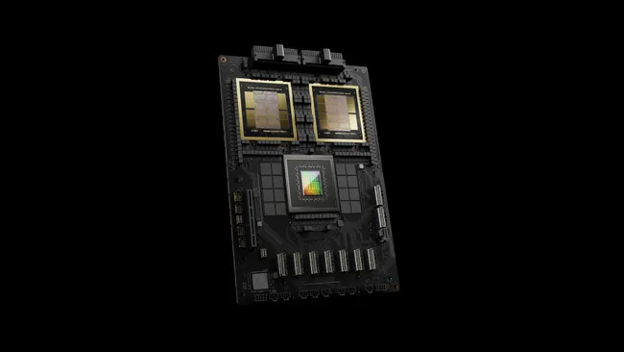

A new report from the Institute for Free Policy (IFP) evaluated whether the United States should allow exports of NVIDIA’s B30A Blackwell-architecture AI chips, a scaled-down version of NVIDIA’s flagship B300, designed for the Chinese market. The report indicates that permitting these exports could significantly reduce the U.S. lead in AI compute and alter the trajectory of global AI development.
A Downgraded Chip With High Strategic Impact
According to IFP, the B30A is expected to deliver approximately half the performance at half the cost, making it a cost-effective option for Chinese AI companies seeking large-scale compute.
Despite its downgraded profile, the chip is projected to exceed U.S. export-control performance thresholds by a wide margin. The report notes that allowing the B30A into the Chinese market would represent a substantial departure from the current strategy, which restricts high-end AI compute from reaching geopolitical competitors.
Modeling Shows a Sharp Decline in U.S. Compute Advantage
IFP modeled multiple scenarios through 2026. Under existing export restrictions, the United States is projected to maintain a 31× advantage over China in frontier AI compute. This assumes zero importing of the B30A into China and effective enforcement of smuggling laws. That dynamic changes markedly if the Blackwell chips are approved for export.
In a limited-export scenario, the U.S. advantage shrinks to under 4×. In a more permissive scenario, one that includes selling a greater supply of chips, China could reach parity or even gain a slight edge by 2026.
The report emphasizes that compute capacity is the primary driver of AI progress. A narrowing gap in available compute could accelerate China’s ability to train large-scale frontier models and compete directly with U.S. capabilities.
The argument supporting the export of downgraded chips is that doing so might slow China’s domestic semiconductor efforts, as NVIDIA and other US chipmakers will take market share from Chinese companies such as Huawei. The IFP analysis challenges this view for two reasons –
- Chinese manufacturers, most notably Huawei, cannot produce chips to meet demand anyway. This is, in part, due to U.S. and allied export controls on semiconductor manufacturing equipment (SME) that limit production.
- China is still driving towards semiconductor independence. The government is pushing state-owned companies to adopt domestic chips while simultaneously limiting AI chip imports.
Policy Recommendations Focus on Manufacturing Controls
Rather than approve exports of the B30A, IFP recommends strengthening controls on key chokepoints within the semiconductor supply chain:
- Semiconductor manufacturing equipment: Tighten restrictions on tools such as DUV immersion lithography machines and close circumvention pathways through third countries.
- High-bandwidth memory (HBM): Increase enforcement and due diligence against HBM suppliers to ensure compliance with export rules.
- Component-level oversight: Enhance monitoring of chip assembly, packaging, and advanced interconnect technologies that could enable China to scale production.
While NVIDIA and other American companies may see commercial upside in expanded sales, the report suggests that the long-term strategic implications outweigh near-term revenue gains. Allowing Blackwell chips into the Chinese market could accelerate model development in ways that current U.S. policy is designed to prevent.