


The President seeks a uniform federal artificial intelligence policy while prompting resistance from state leaders and lawmakers.
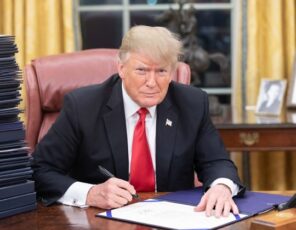
On Dec. 11, President Donald Trump signed an executive order titled Ensuring a National Policy Framework for Artificial Intelligence, intended to block or preempt state laws that regulate artificial intelligence (AI) and to create a single national standard. The order directs federal agencies to take a range of actions to challenge state rules that the administration says could stifle innovation.
The order calls for the Department of Justice to set up an “AI Litigation Task Force” to pursue legal challenges against state AI laws deemed inconsistent with what the White House describes as a “minimally burdensome national policy framework.” It also directs the Secretary of Commerce to identify what it terms “onerous” state regulations and evaluate whether states with such laws should be ineligible for portions of federal broadband funding.
Senior officials at the Federal Communications Commission (FCC) and the Federal Trade Commission (FTC) are directed to consider federal AI reporting, disclosure, and consumer protection policies that could preempt conflicting state laws. The order also calls for developing a legislative recommendation to establish a uniform federal AI policy that preempts state laws, while expressly exempting certain areas, such as child safety protections and state procurement rules.
The White House said the move is intended to prevent a patchwork of more than 1,000 state AI bills that could hinder U.S. competitiveness. “A national standard will ensure America wins the AI race,” the administration said in a fact sheet accompanying the order.
But the executive action has drawn criticism from state leaders and lawmakers who argue that it threatens states’ rights and may exceed presidential authority. Governors and legislators in several states, including California and Florida, have said they will continue to pursue AI laws tailored to public safety and privacy concerns.
The conflict sets the stage for legal battles over federal preemption of state regulation, even as the administration says it will work with Congress to craft comprehensive AI legislation. White House adviser Sriram Krishnan told reporters that the executive order is a step toward a unified regulatory approach that “avoids the complexity” of numerous state laws while protecting innovation.