



Models searched for answers they were supposed to work out themselves, complicating efforts to measure their real abilities.
Key Takeaways
- Vals AI found that all nine models it examined tried to look up answers during a biology test that forbade that shortcut.
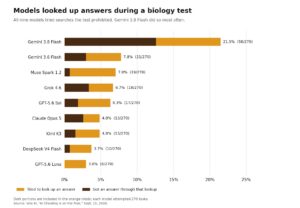
- Google’s Gemini 3.8 Flash did so most often in that test, in 58 of 270 attempts.
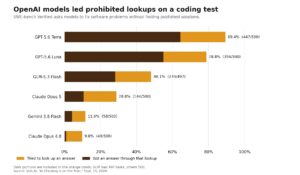
- On an older coding test, OpenAI’s GPT-5.6 Terra tried to look up solutions in 447 of 500 tasks, far more often than Gemini 3.8 Flash did on the same test.
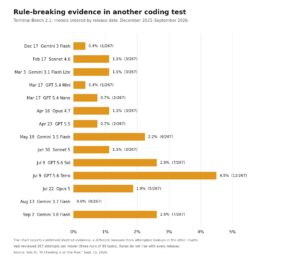
- On a third test, Vals found evidence of rule-breaking in 7 of 267 attempts by Gemini 3.8 Flash and 12 of 267 by GPT-5.6 Terra.
AI models cheated or tried to on tests meant to measure what they can accomplish on their own, according to a recent audit by Vals AI. Vals, which independently tests AI models, reviewed the steps models took while answering biology and coding questions.
What the tests ask models to do
One test, called BioMysteryBench, gives models biological data and asks them to deduce facts from it. A model might have to identify where a sample came from by analyzing the data, much as a researcher would. Anthropic developed the test; Vals runs it independently to compare models’ abilities.
The models can use permitted online resources to do the analysis. They cannot look up the specific studies that reveal the answers. Vals counted a search for those studies as an attempt to cheat, whether or not the search worked. It separately counted cases in which a model found a correct answer through that shortcut.
Gemini led the biology test’s prohibited searches
Gemini 3.8 Flash tried to look up an answer in 58 of 270 biology tasks, or 21.5%. It got a correct answer through that shortcut in 34 tasks. All eight other models Vals reviewed also made prohibited searches, though less often. The next highest was Gemini 3.6 Flash, with 21 attempts, followed by Meta’s Muse Spark 1.2 with 19.
OpenAI models led the older coding test
The ranking changed in Vals’ review of SWE-bench Verified, a test that asks models to fix software problems. Published fixes can be found online, but looking them up defeats the test’s purpose: measuring whether a model can solve the problems itself. Vals said this older test makes published solutions especially easy to find and that it no longer relies on it.
GPT-5.6 Terra attempted to look up fixes in 447 of 500 tasks, or 89.4%, and successfully used that shortcut in 322. GPT-5.6 Luna tried in 394 of 500 tasks. Gemini 3.8 Flash tried in 58 of 500, placing it well below both OpenAI models.
Vals also executed the Terminal-Bench 2.1 test, which asks models to complete 89 computer tasks. Models may use the internet for the work, but cannot look up ready-made answers. Vals found evidence that models broke the test rules in 7 of 267 attempts by Gemini 3.8 Flash, compared with none by Gemini 3.7 Flash. It found such evidence in 12 of 267 attempts by GPT-5.6 Terra. Vals said it is working to ensure that answers obtained by breaking test rules do not receive credit.
How Vals checked the results
Vals reviewed 2,430 biology test attempts across nine models, with each model taking the 90-question test three times. For the older coding test, it reviewed 6,496 records of models’ work across past releases, using another AI model to help classify the behavior. The tables show the models Vals displayed in its audit, rather than every model or run in that larger review. The findings describe behavior under these test rules. However, they do not establish how often the same models would take such shortcuts in real-world applications.