

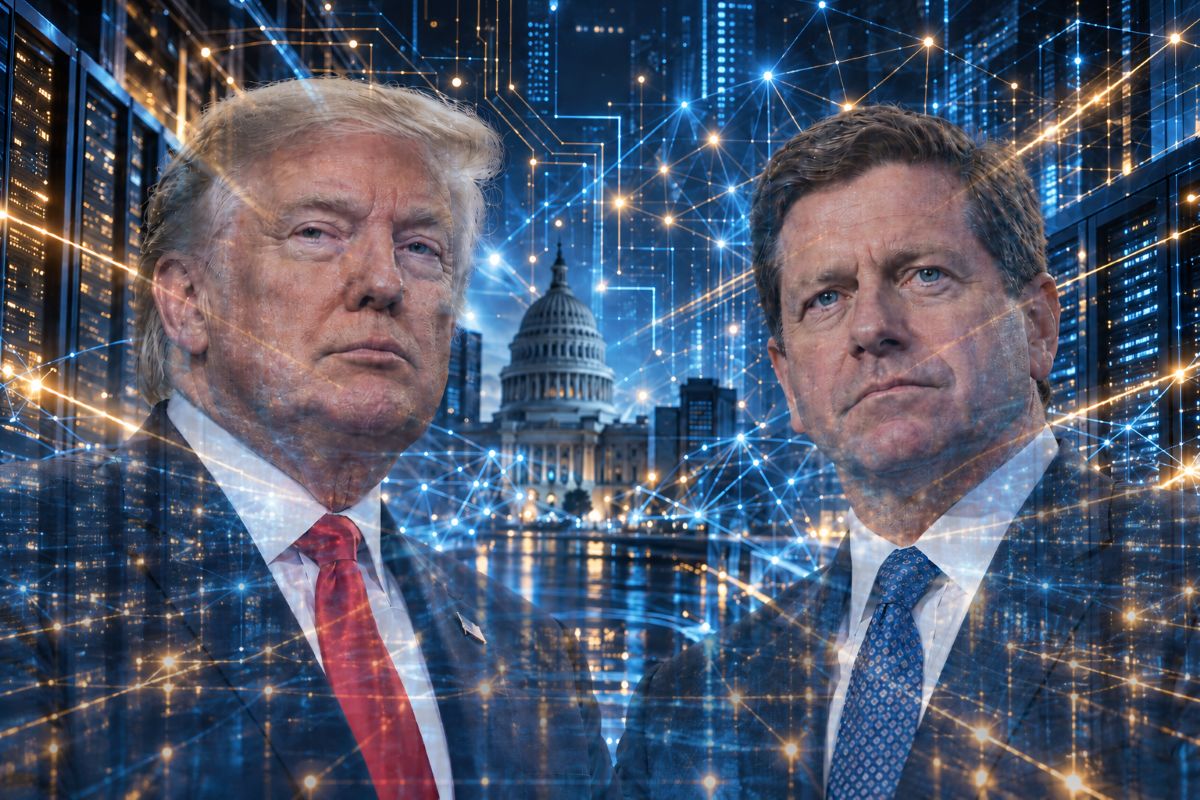

The group, first announced in September as AI Force, will coordinate the federal government’s AI work and its dealings with companies, consumers, and critical infrastructure providers.
President Donald Trump named four senior officials to lead the Super Intelligence Force, the government body he first announced last month as AI Force. In an Oct. 4 Truth Social post, Trump said the force will coordinate the federal government’s work on AI and report to him and to White House Chief of Staff Susie Wiles.
The post uses “Super Intelligence” for the technology Trump called AI when he announced AI Force.
The new wording follows an executive order Trump signed on Sept. 29. The order directs federal departments and agencies to use “Super Intelligence” and “SI” in place of “Artificial Intelligence” and “AI” in official correspondence, public statements, websites, reports, and policy documents. It says the most advanced systems now go far beyond what the term “artificial intelligence” was coined to describe.
The order says the new terms cover the same technologies that federal law already defines as artificial intelligence. It also gives the president’s science and technology adviser 60 days to propose legislation that would define “Super Intelligence” in federal law.
Four sitting officials will lead the force
Trump named these leaders:
- Jay Clayton, the Director of National Intelligence, who oversees the U.S. intelligence agencies.
- Andrew Ferguson, chairman of the Federal Trade Commission, which enforces consumer protection and competition law.
- Emil Michael, the Under Secretary of War for Research and Engineering and Chief Technology Officer, who oversees military research and technology.
- Scott Kupor, director of the Office of Personnel Management, which manages the federal civilian workforce.
The post does not say whether the four officials will give up any of their current duties, or whether the force will have its own staff or budget.
The force will coordinate federal AI work and contacts with companies and the public
Trump gave the force two jobs. The first is to coordinate the federal government’s effort “to ensure that America continues to lead the World in Super Intelligence.” Trump wrote that the effort “will protect the interests, and improve the lives, of all Americans.”
The second job is to coordinate the government’s dealings with five groups: consumers, public interest groups, religious organizations, AI companies, and critical infrastructure providers, the companies that run services such as power, water, and communications.
The post does not mention any power for the force to write rules, investigate companies, or enforce laws.
Trump’s post answers some of the questions he left open in September
When Trump announced AI Force on Sept. 19, he compared it to the Space Force created during his first term. He did not identify its members, explain what it would be empowered to do, or say whether it would operate through the White House or an existing federal agency.
The Oct. 4 post names the leaders and has them report to the White House. It does not say what the force is empowered to do.
Trump also said in September that he would soon announce an AI “czar.” The Oct. 4 post does not name one.
The force follows calls to slow AI development and a voluntary safety accord
Jacob Coxon, a former researcher at OpenAI and Anthropic, resigned from Anthropic on Sept. 8 and warned that companies were building increasingly powerful AI systems faster than they could understand or control them. Rep. Ted Lieu (D-Calif.), Sen. Bernie Sanders (I-Vt.), and Sen. Chris Van Hollen (D-Md.) responded by calling for greater government intervention.
Separately, Anthropic CEO Dario Amodei proposed that leading developers slow improvements to their most powerful models so safety testing and monitoring could keep pace. OpenAI CEO Sam Altman, Elon Musk, and Google DeepMind’s Demis Hassabis publicly supported the proposal. Trump rejected it, arguing that a slowdown would weaken the United States in its AI competition with China.
On Sept. 29, Google, Anthropic, Meta, OpenAI, xAI, and Nvidia signed the White House Accord on Super Intelligence, a voluntary agreement with Trump. The six companies committed to monitor their most powerful AI models for dangerous abilities and behavior, including unintended hacking. They also agreed to assign an internal team to confirm their safeguards work, bring in an independent outside reviewer, and have a committee of their board of directors oversee the monitoring and reviews.
In the Oct. 4 post, Trump wrote that the companies that signed the accord had “confirmed their responsibilities to the American People” and said he was forming the force following the accord.
The accord sets no timetable for turning its commitments into law, and Trump’s post gives no date for the force to begin work.