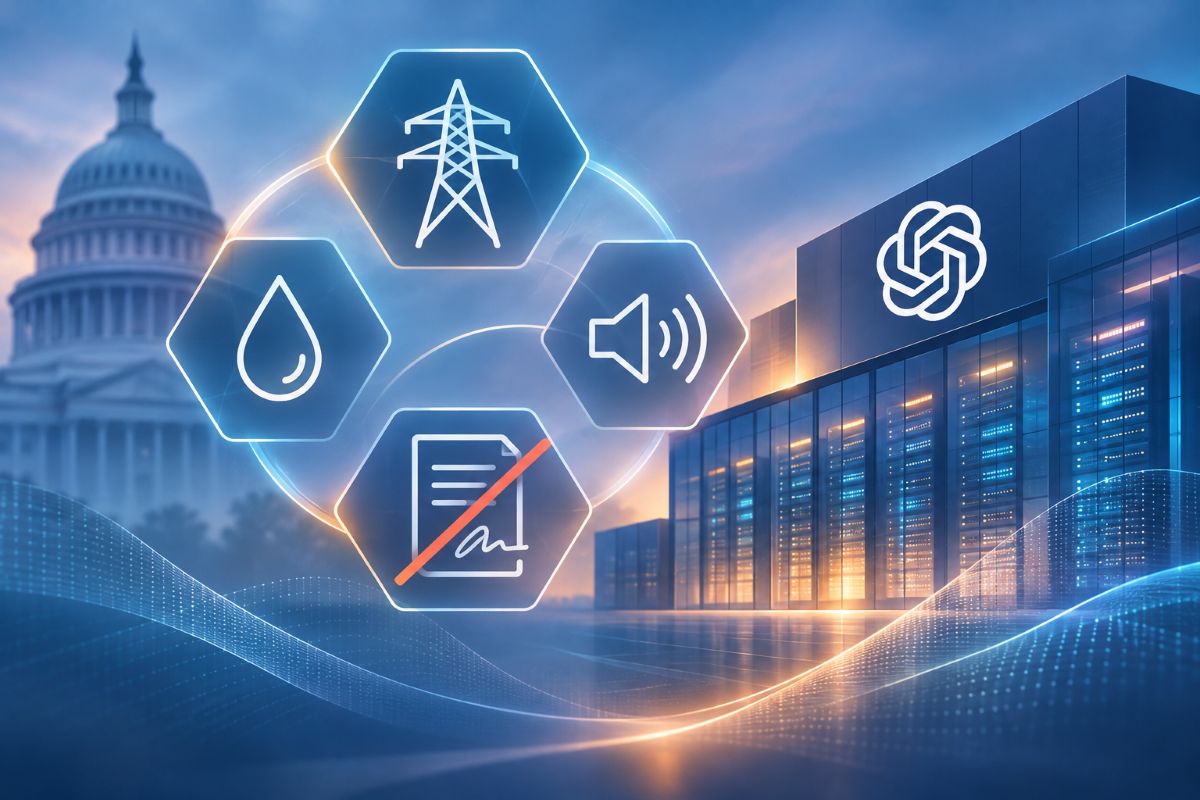

OpenAI’s policy plan would also require data center operators to publish each site’s water, power, and noise data and bar developers from requiring nondisclosure agreements from public officials.
OpenAI promised to pay the full power costs of every future data center it owns and operates. It also promised to publish each site’s water, power, and noise data and to stop asking local officials to sign nondisclosure agreements. OpenAI asked federal, state, and local governments to require the same of every company that builds or runs data centers.
Under the plan, any company running AI data centers would have to pay for its grid upgrades and publish each site’s water, power, and noise figures. States and towns would have to publish the tax breaks they give the companies building data centers. Those governments could take the money back from a company that misses its promises.
OpenAI pledges to pay its own power bills
OpenAI says it will pay the full cost of the electricity its future data centers use, plus the cost of new power lines and equipment needed to serve them. Before major construction spending begins, OpenAI will provide financial guarantees so other ratepayers don’t absorb the costs if a project is delayed, scaled back, or canceled.
In March, OpenAI, Amazon, Google, Meta, Microsoft, Oracle, and xAI signed a voluntary pledge with President Trump to build or buy the new power their data centers need and pay for the grid upgrades they require.
OpenAI promises to report water, power, and noise
OpenAI says it will publish the following figures for each future data center it owns and runs:
- water use and how the site is cooled
- electricity use, including power generated on site
- construction plans covering traffic, noise, and lighting
- noise studies by outside firms, before the site opens and every year after
- jobs created and taxes paid
OpenAI drops nondisclosure agreements with officials
OpenAI says it won’t require public officials to sign nondisclosure agreements, except to protect security information and trade secrets. OpenAI says it already started: in July, it voided its nondisclosure agreements in Effingham County, Georgia, where it plans a data center.
OpenAI asks governments to require the same of all data centers
OpenAI published the plan as recommendations for federal, state, and local governments. OpenAI argues that voluntary promises from companies are not enough to win communities’ trust. Under the plan:
- State utility regulators would make large power users pay for the grid upgrades they need and protect other customers if a project is canceled.
- Lawmakers would ban developers from requiring public officials to sign nondisclosure agreements, with exceptions for security information and trade secrets.
- Lawmakers would require data center operators to publish water, power, noise, jobs, and tax figures for each site.
- States and towns would publish their tax-break deals with developers, tie them to measurable promises, and take the money back when developers fall short.
Voters sided against data centers in 40 of 41 local measures
OpenAI published its promises and proposals on Nov. 5. Two days earlier, on Nov. 3, voters in 10 states decided 41 local ballot measures proposing limits on data center construction. Voters sided against data centers in every measure except one, according to Ballotpedia and CNBC.
Pennsylvania already requires large data centers to pay their own power costs
In August, Pennsylvania Gov. Josh Shapiro signed an order requiring large data centers to cover their own electricity costs before the state issues permits. The order took effect immediately. OpenAI wants utility regulators in every state to make large power users pay for the grid upgrades they need.
OpenAI plans manufacturing proposals next
OpenAI says it will publish more proposals on how data center construction could expand U.S. manufacturing and supply chains.