

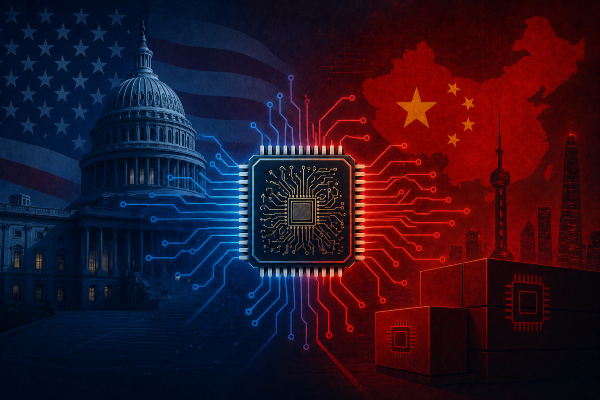

The bill would require annual updates to export thresholds for advanced chips, tying U.S. sales to evolving national security risks and intelligence assessments.
The Semiconductor Controls Adjusted to Limit Exports Act or SCALE Act (H.R. 8306), introduced by Rep. John R. Moolenaar (R-Mich.), would mandate annual reevaluation of the requirements governing the sale of advanced semiconductors to foreign countries to account for changes in the global technological landscape. The intent is to prevent outdated thresholds from allowing adversaries to acquire increasingly powerful chips as technology evolves.
The Secretary of Commerce, in coordination with the Director of National Intelligence, would be responsible for analyzing and adapting these standards in response to changes in the technological capabilities, geopolitical risks, and the latest intelligence findings as they relate to foreign adversaries and their access to Advanced AI hardware.
The legislation focuses on advanced AI chips that underpin high-performance computing and AI systems. These components are critical infrastructure for both commercial AI development and military applications.
The bill’s central mechanism is the creation of a dynamic export control process. Federal agencies would evaluate which countries should face restrictions and what level of compute or chip performance should trigger export limits.
In practice, this would shift U.S. export controls from a fixed-rule system to a more continuously updated model tied to more recent national security assessments. The involvement of intelligence agencies signals a closer alignment between export policy and real-time threat analysis.
Backdrop – Legislation and the AI chip wars
The SCALE Act is another layer proposed to limit the compute capability of China and other US adversaries.
Previous regulations are anchored in the Export Control Reform Act of 2018 (ECRA), which gives the Commerce Department authority to regulate exports for national security and foreign policy reasons.
In October 2022, Commerce, under this legislation, issued new controls restricting China’s access to advanced computing chips and components used in semiconductor manufacturing.
There have been exceptions. In early 2024, NVIDIA created the H20 chip – a processor tailored to the Chinese market based on US government limitations. NVIDIA sold these H20 chips to China while concurrently selling the more advanced Blackwell chips to US and US-friendly companies.
More recently, in January, the Trump administration approved exports of NVIDIA’s H200 AI chips to China under specific conditions, including third-party technical review and a limit tied to the number of chips sold to U.S. customers. The administration also imposed a 25% fee. However, as of now, Commerce Secretary Howard Lutnick said that NVIDIA had not sold the chips to China, citing disagreements over the terms and China’s focus on its own domestic chip industry.
The bill was referred to the House Foreign Affairs Committee and the House Permanent Select Committee on Intelligence for further consideration.