


Draft order would direct federal agencies to challenge state rules and enforce a single national framework.
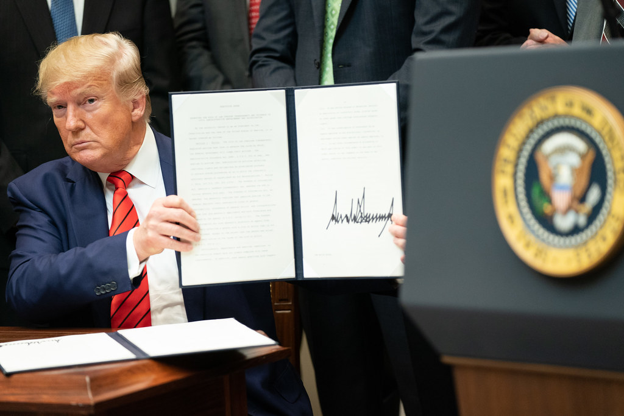
U.S. President Donald Trump announced on Monday that he plans to sign an executive order “this week” that would block states from enforcing their own laws regulating artificial intelligence (AI), aiming to impose a single nationwide regulatory framework.
According to the draft order, the federal government would direct agencies, including the Department of Justice (DOJ), Federal Trade Commission (FTC), and Federal Communications Commission (FCC), to take steps against what the White House deems burdensome state AI laws. The plan reportedly includes establishing an “AI Litigation Task Force” to challenge state statutes in court and, if necessary, suspend federal funding, such as broadband aid, to states that adopt laws that conflict with the national policy framework.
In a post on Truth Social, he wrote: “There must be only One Rulebook if we are going to continue to lead in AI… You can’t expect a company to get 50 Approvals every time they want to do something.” He added that allowing states to set their own rules would kill AI “in its infancy.”
The initiative comes amid a flurry of state-level AI legislation in 2025: all 50 U.S. states, as well as territories and D.C., considered AI-related bills this year, and 38 states passed or enacted roughly 100 measures. States such as California and Colorado have already advanced laws targeting high-risk AI systems, mandating transparency, risk assessments, and protections against deepfakes, bias, and misuse.
But the proposed federal preemption has stirred opposition, including from leaders of Trump’s own party. Governor Ron DeSantis (R-Fla.) voiced skepticism, writing that only Congress, and not the president, can block state legislation. He argued that the move would amount to “AI amnesty” and strip states of the ability to safeguard residents.
Even as Congress earlier rejected a ten-year moratorium on state AI regulation by a 99–1 Senate vote, the White House remains poised to use executive authority.
Some major technology firms and industry groups support the executive order, arguing that a national standard is essential to prevent a patchwork of conflicting laws that would hinder innovation and disadvantage U.S. companies competing globally.
The forthcoming executive order could reshape the governance of artificial intelligence in the United States, overriding a wave of state-level laws passed this year in favor of a unified federal framework.