

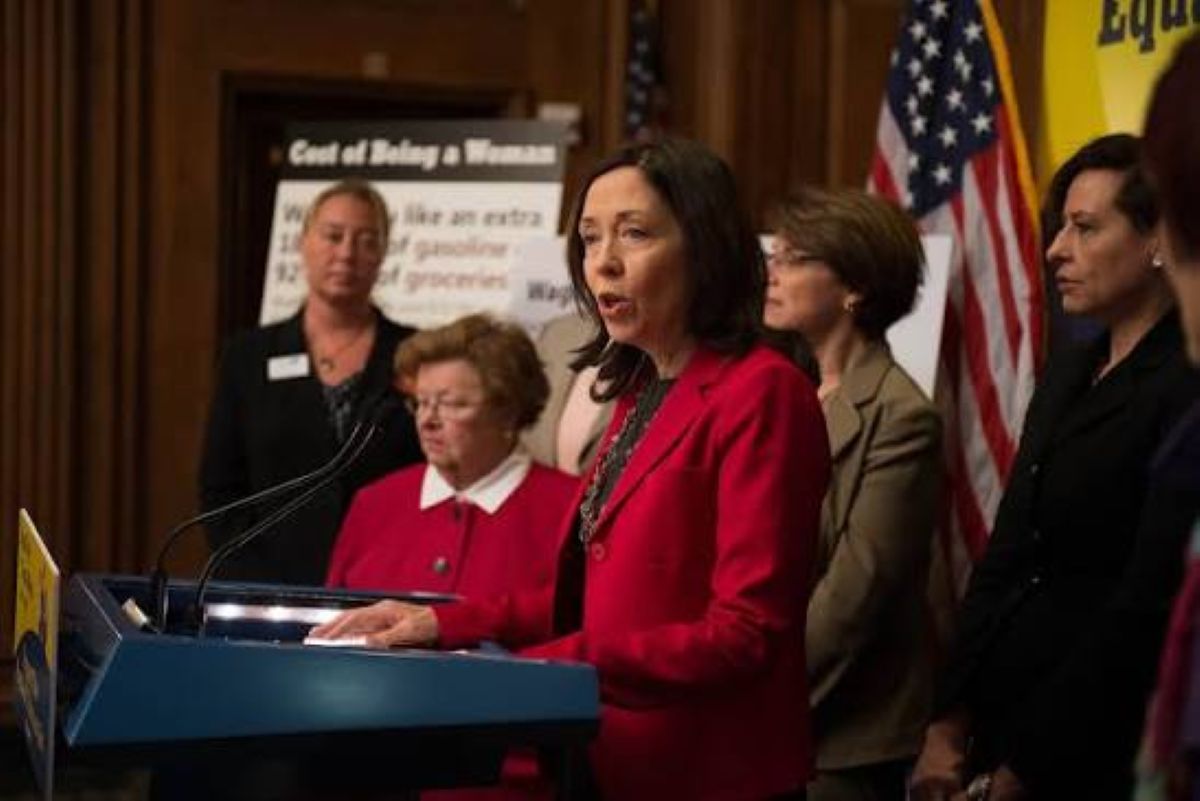

The top Democrat on the Senate Commerce Committee says the most powerful AI models should not be released until an outside audit confirms they meet federal safety standards.
Sen. Maria Cantwell (D-Wash.) announced a plan on Oct. 7 for how the federal government should oversee the most powerful AI systems. The plan rests on six principles: safety standards the government can enforce; independent testing to verify that AI models meet them; disclosure and accountability from developers; partnerships between government and industry; protections for children and workers; and U.S.-led cooperation with other countries.
Cantwell is the top Democrat on the Senate Committee on Commerce, Science and Transportation and a former chair of the committee. She said she has promoted many of the six principles for years.
“To manage risks from advanced AI systems, we need clear safety standards, continuous testing, and reporting of serious failures,” Cantwell said.
Federal experts would write standards aimed at catastrophic harm
Under the plan, the National Institute of Standards and Technology (NIST), the federal agency that sets technical standards, would write the safety standards with other federal agencies.
The standards would target four kinds of catastrophic harm: AI-enabled cyberattacks; AI helping someone build chemical, biological, radiological, or nuclear weapons; people losing control of an AI system; and AI agents escaping the closed-off computer systems where developers test them.
Separate standards would cover open-source models, whose core files anyone can download and modify.
Models would need an independent audit before release
Cantwell said the standards cover models that should not be released until an independent audit confirms they comply. She compared the audits to the way outside accountants examine a company’s financial statements. Government and independent experts would also keep testing the models after release.
Cantwell’s announcement does not say which models it would cover.
Developers would have to disclose risks, report failures, and remain liable
Developers would have to give qualified outside testers and auditors access to their models, along with the requested information needed to determine whether a model could cause catastrophic harm.
They would publish plain-language descriptions of their models’ serious safety and security risks and what they are doing about them, modeled on the risk disclosures public companies give investors.
They would have to promptly report serious incidents, including losing control of an AI agent, a model showing dangerous hacking abilities, and a major safeguard failure.
Developers would remain liable under civil and criminal law for harms their AI systems could foreseeably cause, including when a failure to put reasonable safeguards in place contributes to the harm. Employees and contractors who report safety concerns would be protected from retaliation.
The other principles cover industry partnerships, children, workers, and other countries
Industry partnerships. Government and AI companies would work together on AI that detects and stops cyberattacks. AI companies would also share computing power and tools with smaller businesses and public institutions.
Children and workers. AI products used by children would have to protect their safety. AI companies would help fund worker training. When AI informs a decision about someone’s job, health care, or credit, that person could challenge it and have a qualified person review it.
Other countries. The United States would work with allies on shared safety standards. Cantwell also called for a direct line to China, like the Cold War “red phone,” for use during a serious AI incident.
The White House wants a different approach
In the two weeks before Cantwell’s announcement, President Donald Trump took two actions of his own on AI.
On Sept. 29, six AI companies, including OpenAI, Anthropic, and Google, signed a voluntary agreement with Trump. They committed to monitor their most powerful AI models for dangerous abilities and to have outside reviewers check their safeguards.
On Oct. 4, Trump named four officials to lead the Super Intelligence Force, a White House body that will coordinate the federal government’s AI work and its dealings with AI companies and the public. Trump’s announcement describes a coordinating role and does not mention powers to write rules or enforce laws.
Like the White House agreement, Cantwell’s plan relies on outside review of developers’ safeguards. Unlike the agreement, it would make that review a federal requirement before releasing a model. It would also add incident reporting and legal liability for developers
Cantwell has not introduced a bill
The plan is a set of principles, not legislation. Cantwell’s announcement does not say whether she will turn it into a bill.